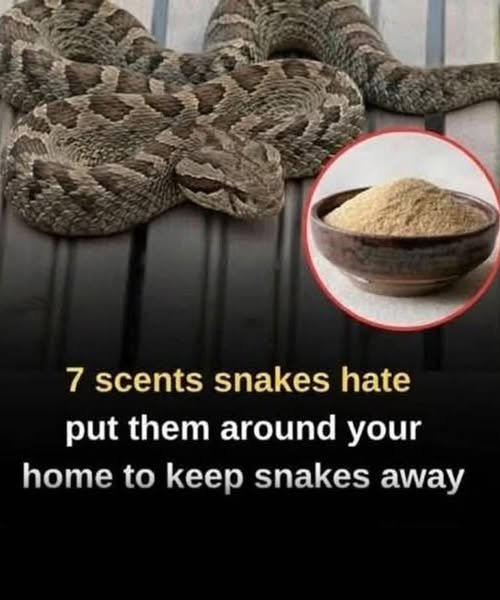
🐍 7 Smells Snakes Are Said to Hate — And What Actually Helps Keep Them Away From Your Home
Seeing a snake near your home can be unsettling, especially when you have children, pets, or a garden nearby. That’s why viral posts often recommend strong-smelling ingredients such as cinnamon, garlic, vinegar, or sulfur as a natural snake repellent.
But there’s an important distinction between an odor that sounds unpleasant to humans and a method scientifically proven to keep snakes away.
In fact, university extension guidance says commercially marketed snake repellents have not been shown to work consistently, and some popular remedies—especially mothballs and sulfur—can be ineffective or hazardous when misused. Penn State Extension
So rather than promising that these seven smells will create a “snake-proof” yard, here’s what you should know.
🌿 1. Garlic
Garlic is frequently mentioned in homemade snake-repellent recipes because of its strong odor.
Some wildlife-repellent guidance notes that garlic-containing products can have repellent effects against certain animals, but this should not be interpreted as proof that garlic will reliably keep snakes away from a property. Extension UGA
If you want to try it
You can make a simple garlic spray:
4–5 crushed garlic cloves
2 cups of water
1 teaspoon mild dish soap
Blend or crush the garlic with the water, let it sit for several hours, strain it, and add the soap. Spray around non-edible ornamental areas, rather than directly on a snake.
Reapply after heavy rain.
Important: This is a homemade deterrent experiment, not a guaranteed snake-control method.
🌿 2. Peppermint or Mint
Mint and peppermint are popular online because they have a strong scent.
Some extension information discusses garlic and mint oils as area repellents with some success for wildlife generally, but that doesn’t establish reliable snake control. Extension UGA
If you already grow mint, planting it around parts of your garden is perfectly reasonable—but don’t depend on it as your primary snake-prevention strategy.
🍋 3. Vinegar
Vinegar is another frequently recommended household remedy.
However, there isn’t good evidence that simply pouring vinegar around your property will reliably prevent snakes from entering.
And using large amounts of vinegar can damage plants and soil surfaces.
Don’t spray concentrated vinegar indiscriminately around your garden.
🌶️ 4. Hot Pepper or Cayenne
Cayenne and other pepper-based mixtures are often promoted online as snake deterrents.
The problem is that homemade pest remedies can have unpredictable effectiveness and can potentially irritate people, pets, plants, and wildlife. Penn State Extension specifically cautions that many internet home remedies lack precise instructions and may not be effective or safe. Penn State Extension
So if you see a recipe claiming that cayenne creates an invisible “snake barrier,” treat that claim skeptically.
🌱 5. Cinnamon or Clove
Cinnamon and clove have very strong aromas, which is why they’re commonly included in viral snake-repellent lists.
You can place small amounts of dried spices around areas where you don’t want pests, but there is not strong evidence that cinnamon or cloves will reliably prevent snakes from entering a yard or house.
Don’t assume that a strong smell to humans automatically equals an effective wildlife repellent.
🧅 6. Onion
Onions are sometimes recommended alongside garlic because of their pungent odor.
Like the other homemade remedies above, there isn’t reliable evidence that placing onions around your property will create a dependable barrier against snakes.
If snakes are repeatedly appearing, addressing why they’re there is much more useful.
⚠️ 7. Sulfur — A Viral Favorite You Should Be Careful With
This is one of the most important myths to address.
Many online posts recommend sprinkling sulfur around the house because snakes supposedly hate the smell.
However, University of Georgia Extension specifically states that sulfur products sold as snake deterrents have been found ineffective and can be dangerous if they create a false sense of security. Extension UGA
Don’t scatter chemicals around your property simply because a viral post calls them “natural.”
🚫 What About Mothballs?
Don’t use mothballs to repel snakes.
This is one of the most persistent internet myths.
Mothballs are pesticides intended for specific labeled uses, not for scattering around yards to repel snakes. Extension specialists warn that outdoor use can expose people, pets, wildlife, and the environment to harmful chemicals. UGA Extension
So if you see a recipe saying:
“Put mothballs around your house and snakes will never return.”
Skip it.
🏡 What Actually Works Better?
If your goal is to reduce snake encounters, habitat modification and exclusion are much more practical than trying to perfume the yard.
This is one of the biggest things homeowners overlook.
If mice and rats are abundant around your property, predators—including snakes—may have a reason to visit.
Secure garbage and animal feed, remove food sources, and keep storage areas clean.
3. Keep grass and vegetation maintained
Tall grass and dense vegetation provide cover for both snakes and the animals they hunt.
Keeping the area around buildings maintained can reduce suitable habitat. UGA Extension
4. Seal openings
Inspect:
Foundation cracks
Gaps beneath doors
Torn screens
Basement windows
Openings around pipes and cables
Vents
Penn State Extension recommends sealing openings because snakes can enter buildings through surprisingly small gaps. Penn State Extension
5. Keep firewood elevated
Don’t store large piles of wood directly against the house.
Keeping wood elevated and away from the building reduces potential shelter and makes inspection easier. Penn State Extension
🐍 If You Find a Snake
Don’t try to grab, corner, or kill it.
Give it space and keep children and pets away.
If you’re concerned that it could be venomous, don’t attempt to identify it by getting close. A local wildlife professional can help with safe removal.
Many snake bites happen when people attempt to handle or kill snakes. UGA Extension
🧠 The Bottom Line
There are plenty of viral lists claiming that garlic, peppermint, cinnamon, vinegar, onion, cayenne, or sulfur will make snakes stay away.
But there is no reliable “7-smell recipe” that guarantees a snake-free property. University extension sources emphasize that exclusion, habitat modification, and reducing food and hiding places are more dependable strategies. Penn State Extension
If you want to try a mild homemade odor spray, treat it as an optional experiment—not as your main line of defense.
The best snake repellent is often a home and yard that gives snakes fewer reasons and fewer opportunities to stay. 🏡🐍
⚠️ Safety Note
Never use pesticides, mothballs, sulfur, essential oils, or homemade chemical mixtures around children or pets without checking the product label and appropriate safety guidance. “Natural” does not automatically mean harmless.
Have you ever found a snake around your home? What method did you try to keep it away? 👇