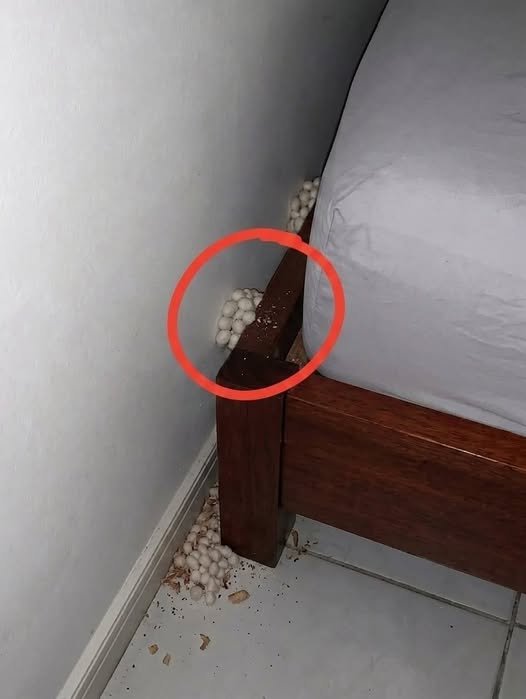
What Are Those Strange White Clusters Under the Bed? The Answer May Surprise You
Finding a strange pile of tiny white objects beside your bed would be enough to make almost anyone stop and take a closer look.
At first glance, the small white pieces in this photo could easily be mistaken for eggs, seeds, or even bits of foam. But the location and appearance provide some important clues.
So, What Are They?
The white objects appear to be ant brood—developing ants such as larvae and pupae, rather than ordinary household debris.
Ant colonies carefully protect their developing young. Eggs, larvae, and pupae are typically kept in protected nest areas, and worker ants move the brood when conditions in the nest change or when the colony is disturbed. Entomology sources describe the pale, rice-like material commonly seen around disturbed ant colonies as developing ant brood. (Ask an Entomologist)
In this particular photo, the white clusters are gathered around the wooden bed frame, which could indicate that ants have established a nest or satellite nesting area nearby.
Why Would Ants Be Near a Bed?
Ants don’t necessarily choose a bedroom because they are attracted to the bed itself.
They may be using:
Small gaps around the wall or floor
Cracks in wooden furniture
Protected spaces inside or beneath furniture
Areas affected by moisture
Nearby spaces where food or other resources are available
Some household ants can establish nests in or around buildings, and identifying where the workers are coming from can help locate the colony. (Pest World)
Are They Termite Eggs?
This is where things can get confusing.
The white objects may look somewhat like termite eggs, but termite eggs are rarely encountered exposed in an open area. Termite eggs are normally kept inside protected portions of the colony. (Engineer Fix)
The material shown in the image is therefore more consistent with ant brood than with a visible pile of termite eggs, although a photograph alone cannot establish the exact insect species with certainty.
Why Are the White Objects So Important?
Ant brood includes several developmental stages. Ants go through egg, larval, and pupal stages before becoming adults.
The developing young are pale and can look surprisingly similar to tiny grains of rice. Worker ants care for them, move them, and protect them from threats. (Ask an Entomologist)
That means what looks like a strange pile of little white balls may actually represent a developing colony of insects.
What Should You Do If You Find Something Similar?
Don’t immediately assume that the material is harmless or that it is definitely termites or ants.
Instead:
Take a clear close-up photograph.
Look for live insects moving around the area.
Check cracks, joints, and gaps around the furniture.
Inspect nearby wood for signs of damage.
Avoid disturbing the material unnecessarily until you know what you’re dealing with.
If insects continue appearing or you suspect an infestation, consider contacting a qualified pest-control professional. Proper identification is important because different pests require different approaches. (Pest World)
One More Important Detail
The photo alone isn’t enough to identify the exact ant species—or to completely rule out another insect.
So rather than saying “these are definitely termite eggs” or “these are definitely ant eggs,” the safest identification is:
They appear to be ant brood, likely larvae or pupae, associated with an ant nest or nesting area.
Final Thoughts
What initially looks like a mysterious pile of white beads may actually be something much more biological: young ants being protected and moved by worker ants.
And that’s what makes photographs like this so fascinating—ordinary household spaces can sometimes reveal surprisingly complex insect activity.
Have you ever discovered something like this around your furniture or home? 🐜