🤍 Have You Noticed Small White Spots on Your Arms or Legs? Here’s What They Could Be
Small white or lighter spots on the arms and legs are surprisingly common—especially as people get older. But despite what many social-media posts suggest, they don’t automatically mean you’re deficient in vitamins or calcium.
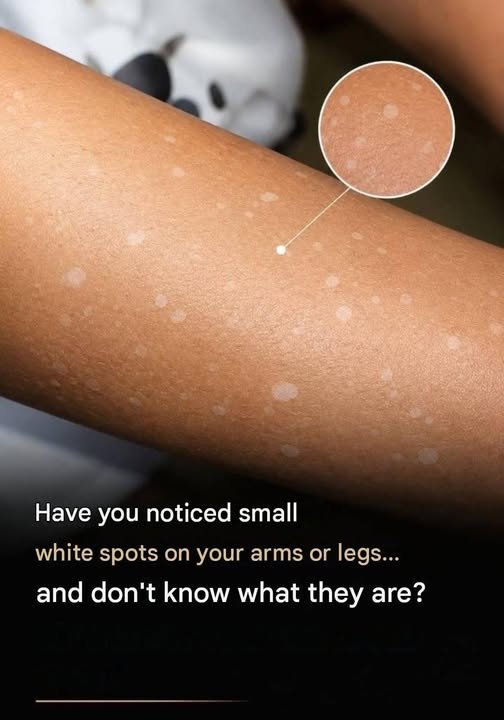
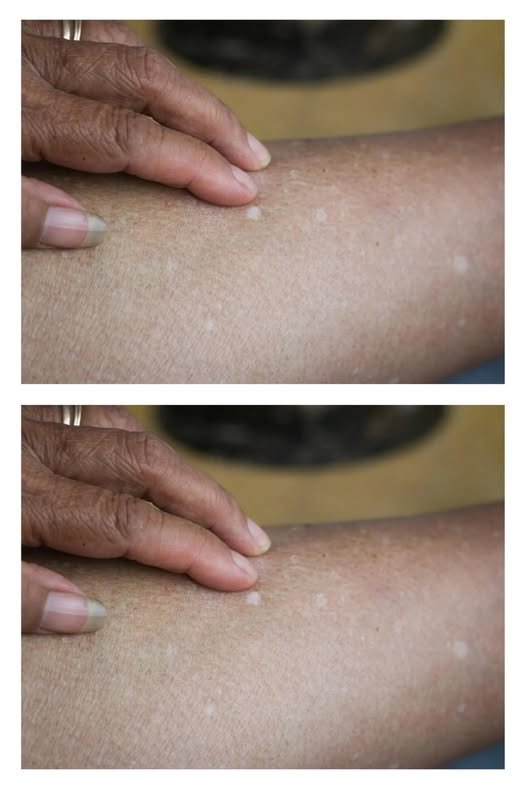
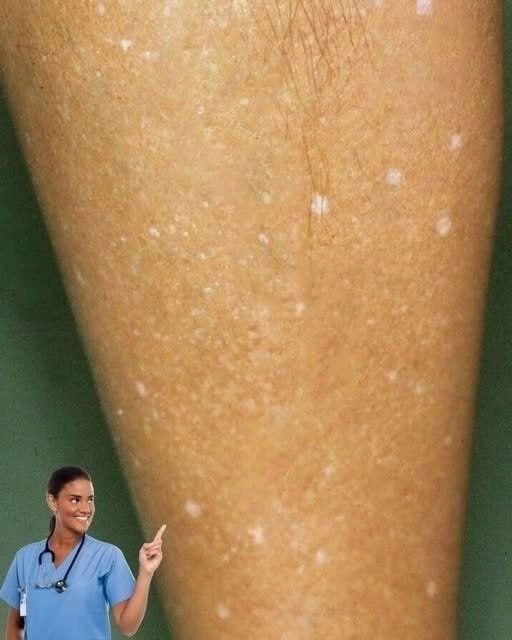
The appearance in this image can be seen with a condition called idiopathic guttate hypomelanosis (IGH), although a photograph alone cannot confirm a diagnosis.
🔎 One common possibility: Idiopathic Guttate Hypomelanosis
IGH causes small, flat, pale or white spots, most commonly on sun-exposed areas such as the forearms and lower legs.
The spots are usually:
Small—often just a few millimeters
Flat and smooth
Multiple
Not painful
Usually not itchy
More noticeable against darker or tanned skin
IGH is considered benign, and it becomes increasingly common with age. Chronic sun exposure and normal skin aging are thought to contribute to its development. DermNet®
So if you’ve gradually developed numerous tiny white spots on your arms or legs, particularly after your 40s, IGH is one possibility worth knowing about.
⚠️ But white spots can have other causes
This is where viral posts often oversimplify things.
Vitiligo
Vitiligo occurs when pigment-producing cells are destroyed, resulting in lighter or completely white patches. It can affect the arms, legs, hands, face and other areas. Académie Américaine de Dermatologie
This is a common superficial yeast infection of the skin. It can produce lighter or darker spots, sometimes with fine scaling or itching. It’s particularly common in warm, humid climates. Académie Américaine de Dermatologie
Post-inflammatory hypopigmentation
A lighter patch can remain after an injury, rash, burn, acne or other inflammation has healed. The American Academy of Dermatology lists skin injury and several skin conditions among causes of lighter areas. Académie Américaine de Dermatologie
🩺 How can you tell which one you have?
Sometimes the pattern and appearance are enough for a dermatologist to make a diagnosis. In uncertain cases, additional examination can help.
For example, a dermatologist may use a Wood’s lamp or, when appropriate, examine a small skin sample. Wood’s lamp examination can also help distinguish certain pigment disorders and infections. Académie Américaine de Dermatologie
That’s why it’s better not to assume that every white spot is vitiligo—or that every spot is caused by a vitamin deficiency.
☀️ Protect those areas from the sun
Even when the spots themselves are harmless, sun protection is worthwhile.
Because the surrounding skin becomes darker with tanning, existing light spots can become much more noticeable. DermNet recommends sun protection for people with IGH, while the AAD recommends broad-spectrum sunscreen as part of managing many pigmentation disorders. DermNet®
Consider:
Broad-spectrum SPF 30+
Protective clothing when exposed to strong sun
Avoiding tanning beds
Keeping the skin moisturized
Avoiding harsh scrubbing or irritating homemade treatments
🚫 Don’t automatically take supplements
A common internet explanation is:
“White spots = calcium deficiency.”
That’s not a reliable diagnosis.
Don’t start high-dose vitamin or mineral supplements simply because you notice white spots. If you have other symptoms suggesting a nutritional deficiency, a healthcare professional can decide whether testing is appropriate.
👩⚕️ When should you get the spots checked?
Consider seeing a dermatologist if:
The spots are rapidly increasing
They are becoming larger or merging
They are bright white with sharply defined borders
Hair within the affected area turns white
There is scaling, itching or inflammation
The spots appeared suddenly
You’re unsure what they are
A proper diagnosis is especially useful because IGH usually requires reassurance rather than treatment, while conditions such as tinea versicolor or vitiligo may have specific treatment options. DermNet®
🤍 Bottom Line
Small white spots on the arms or legs are not automatically a sign of a vitamin deficiency or serious disease.
When there are many tiny, flat spots on sun-exposed limbs—particularly with increasing age—idiopathic guttate hypomelanosis is one common possibility. But vitiligo, tinea versicolor and post-inflammatory changes can look similar, so a dermatologist is the best person to distinguish them. DermNet®
Have you noticed these small white spots on your arms or legs? Are they increasing over time, or have they stayed the same?