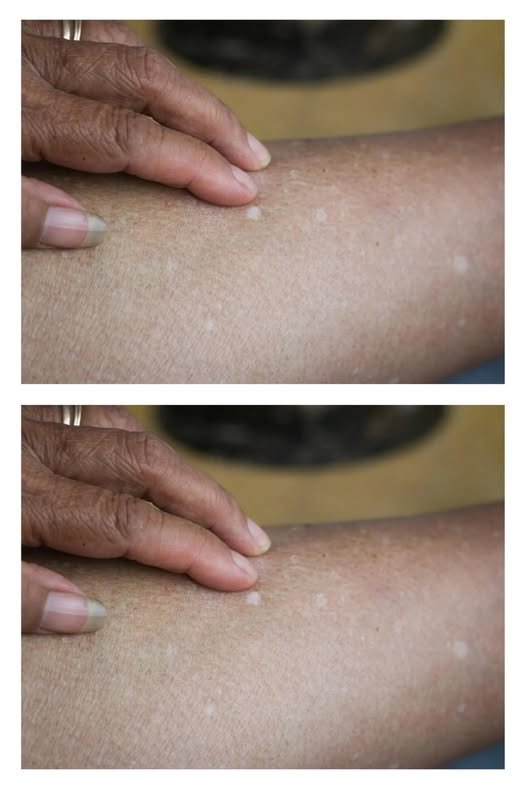
Small white or lighter patches on the skin can be surprisingly noticeable, especially on darker skin tones. The image shows several pale spots on the lower leg, but a photograph alone cannot determine the exact cause.
Although social-media posts sometimes describe these spots as the “first symptoms” of one particular disease, there are several possible explanations.
1. Vitiligo
One possibility is vitiligo, an autoimmune condition in which pigment-producing cells are damaged, causing areas of skin to lose their normal color.
Vitiligo can begin as small pale patches and gradually become more noticeable. The patches may occur on the hands, face, arms, legs, or other parts of the body.
The affected skin is usually smooth rather than scaly.
2. Idiopathic Guttate Hypomelanosis
Another possibility, particularly in adults and older adults, is idiopathic guttate hypomelanosis (IGH).
This condition causes multiple small, flat, lighter-colored spots, commonly on areas that receive a lot of sun, such as the arms and legs. The spots are generally harmless and aren’t contagious.
They can become more noticeable with age and cumulative sun exposure.
3. Tinea Versicolor
A fungal/yeast-related skin condition called tinea versicolor can also produce lighter patches.
Unlike some forms of vitiligo, these patches may have fine scaling and can sometimes be itchy. They are commonly found on the chest, back, shoulders, or upper arms, although other areas can be affected.
4. Changes After Skin Inflammation
A previous rash, insect bite, injury, burn, or other inflammation can sometimes leave an area of skin lighter than the surrounding skin. This is called post-inflammatory hypopigmentation.
The original problem may have disappeared before the lighter area becomes obvious.
🔎 How Can You Tell the Difference?
A dermatologist may consider:
Whether the patches are completely white or only slightly lighter
Whether they are increasing in number or size
Whether they have scales
Whether there was a previous rash or injury
Where the spots are located
Whether similar patches occur elsewhere
A Wood’s lamp examination can sometimes help a clinician distinguish certain pigment disorders.
🚨 When Should You Have the Spots Checked?
It’s worth seeing a healthcare professional if the patches:
Are new and continuing to spread
Become completely white
Appear suddenly in multiple areas
Develop scaling, itching, redness, or discomfort
Are accompanied by other unusual skin changes
Cause you concern about vitiligo or another skin condition
Don’t Assume It’s a Vitamin Deficiency
White spots are frequently attributed online to deficiencies of calcium, vitamin D, or other nutrients. The appearance of white spots alone cannot establish a vitamin deficiency.
Taking supplements without confirming a deficiency isn’t a reliable way to treat unexplained skin discoloration.
☀️ Protect the Skin From the Sun
Lighter areas contain less pigment and may be more vulnerable to sunburn. Using sunscreen on exposed skin and avoiding excessive sun exposure can help protect both the affected areas and the surrounding skin.
The Bottom Line
White spots on the skin are a symptom, not a diagnosis. They can occur with vitiligo, idiopathic guttate hypomelanosis, fungal infections, previous inflammation, and several other conditions.
If you’re noticing new or spreading white patches, getting the skin examined is much more useful than trying to identify the cause from a social-media image.
This article is for general educational purposes and does not diagnose the condition shown in the photograph.