Don’t Get Fooled by the Supermarket: Why Ground Beef Can Look Bright Red or Dark Purple
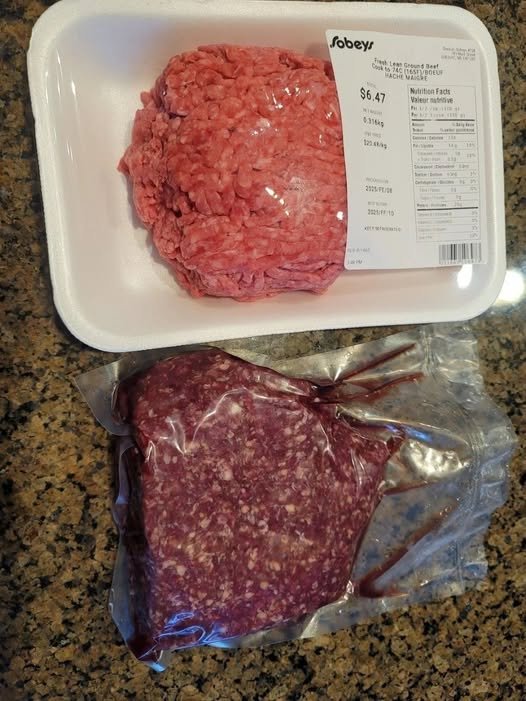
Have you ever noticed that one package of ground beef looks bright red, while another looks dark red or almost purple?
A viral post may suggest that supermarkets are doing something suspicious to make old meat look fresh.
The reality is much simpler: the color of raw beef is strongly affected by oxygen. The difference shown in the photo does not, by itself, prove that one package is fresher or that a supermarket is deceiving customers. Ask USDA
🥩 Why Is One Package Bright Red?
Fresh beef that is exposed to oxygen develops a pigment called oxymyoglobin, which gives the meat its familiar cherry-red appearance.
That’s why ground beef displayed in a package that allows oxygen to reach the meat can look especially bright red.
The color is therefore partly a result of the meat’s interaction with air—not simply an indication of how fresh it is. Ask USDA
🟣 Why Does Vacuum-Packed Beef Look Purple?
This is where the viral image can be misleading.
When beef is protected from oxygen—for example, inside vacuum packaging—its myoglobin remains in a form that gives the meat a purplish-red or burgundy appearance.
When the package is opened and the meat is exposed to air, it can become noticeably redder.
That purple color does not automatically mean the meat is spoiled. Ask USDA
So the darker meat in the bottom portion of the photograph could simply be showing what beef looks like when it has had limited exposure to oxygen.
🧬 The Real Explanation: Myoglobin
Myoglobin is a protein found in muscle tissue that helps store oxygen.
Its chemical state changes depending on how much oxygen is available, producing different colors.
That’s why the same piece of beef can look:
Purple-red → after limited oxygen exposure
Bright cherry-red → after exposure to oxygen
Brownish-red → after prolonged exposure to oxygen
These color changes are not automatically evidence of manipulation or spoilage. Ask USDA
⚠️ Does Brown Beef Mean It’s Bad?
Not necessarily.
USDA guidance explains that color changes alone aren’t enough to determine whether meat is safe or spoiled. Beef can become brownish-red as myoglobin reacts with oxygen over time. Ask USDA
However, if meat has been stored too long and develops an unpleasant odor or a sticky/slimy surface, those are more concerning signs of spoilage. Ask USDA
Always follow the package’s use-by guidance and keep raw ground beef properly refrigerated.
🌡️ Color Can’t Tell You Whether Ground Beef Is Safe to Eat
This is one of the most important facts.
You cannot reliably determine whether ground beef is safe simply by looking at its color.
USDA recommends cooking ground beef to an internal temperature of 160°F (71°C), measured with a food thermometer. Ask USDA
Even properly cooked ground beef can sometimes remain slightly pink, so color isn’t a reliable way to determine doneness either. Ask USDA
🧊 How Should You Store Ground Beef?
Keep raw ground beef refrigerated at 40°F (4.4°C) or below.
USDA guidance says ground beef should generally be used within 2 days when refrigerated, or frozen for longer storage. Ask USDA
And remember: vacuum packaging does not make raw meat safe to keep at room temperature. Vacuum-packed meat still needs refrigeration or freezing. Ask USDA
🛒 So Is the Supermarket “Fooling” You?
The photo doesn’t establish that.
A bright-red package isn’t automatically fresher than a purple-looking vacuum-packed package. Packaging and oxygen exposure can produce dramatically different colors in otherwise normal beef.
Instead of judging ground beef solely by its color, check:
The package condition
Storage temperature
Date/use-by information
Odor and surface condition
Whether the packaging is damaged or leaking
Proper cooking temperature
The Bottom Line
Bright red doesn’t automatically mean fresh, and purple doesn’t automatically mean spoiled.
The difference is often explained by myoglobin and oxygen exposure. Vacuum-packed beef can naturally look darker or purplish until exposed to air. Ask USDA
And when you cook ground beef, don’t rely on color—use a food thermometer and reach 160°F (71°C).Ask USDA
This article is for general food-safety education. When in doubt about meat that has been improperly stored, has a strong off odor, or has a suspicious texture, it is safer not to eat it.